Safety Reminder as Late Fall and Winter Approach

Late-season hikes can be very rewarding, but unplanned delays in the woods can happen for various reasons. In this season of cooler temperatures and shorter days, everyone taking part should have with them 1) a headlamp with sufficient batteries and 2) enough layers of clothing to stay warm in the event of a prolonged stop. Always be aware that incidents requiring a stop for one or more hours can and do happen in the Chapter’s local area.

NYNoJ Chapter Hike Leaders Day Hike – Central Park NY (Easy) 11/7/26

Hello everyone!

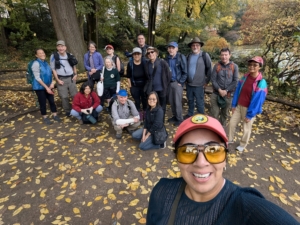
Today's get-together was fantastic! Thank you to everyone who was able to join us. The weather was beautiful, and the conversations were wonderful and encouraging. 

I hope we can continue finding opportunities to connect with one another as often as our schedules allow. Fortunately, we have a couple more chances to do just that! Below are two upcoming events I encourage you to consider attending:

Saturday, November 14th: New York-North Jersey Annual Business Meeting and Dinner

Wednesday, December 16th: NY-NoJ Holiday Party 2026 

It would be great to see you there. Looking forward to more opportunities to connect, share, and enjoy one another's company! Have a great night!

Happy Trails,
Gwen Hartstein
Hike Chairperson
AMC New York-North Jersey Chapter

Update: Activity Design Lab Project

A few very interesting items came up at the Nov. 4, 2026 Activity Design Lab project meeting, which is a joint staff/volunteer effort to develop standards for leading ‘accessible’ and ‘relaxed’ activities across the entire organization.

It turns out one of the difficulties in developing club-wide standards is that the current Leader Requirements and Guidelines (LRG), establishes minimum qualifications for leaders, but allows activity and program committees within the chapters to add additional skill and experience requirements to address differences in terrain, among other factors.  This aspect of the LRG is one reason tackling leader requirements has become so difficult.  For that reason, instead of developing minimum qualifications for leaders, the Activity Design Lab project will develop maximum standards: meaning, chapters, including volunteer-run camps and cabins, and staff-managed volunteer naturalists operating from AMC’s various lodges, may be able to waive various leader requirements, but cannot impose additional requirements than those developed by the Activity Design Standards Law.
For example, the naturalists headquartered at AMC lodges are not required to have Wilderness First Aid and CPR training, whereas naturalist volunteers at Echo Lake Camp and Cold River Camp are required to have these certifications.  Because the leaders of these level 1 and level 2 ‘accessible’ and ‘relaxed’ activities routinely have children and young adult participants, a criminal background check is also required.  Compare this to current level 1 and level 2 activity standards at New York-North Jersey, where neither wilderness first aid nor a criminal background check are required.  If accessible and relaxed activities grow at our chapter and attract more families, it’s possible (and likely) a criminal background check will be required, although (in my view) unlikely wilderness first aid and CPR will be required, but of course that remains to be determined.   Anyone who wants to be on the Activity Design Lab Project team has until close of business Monday, November 9, 2026 to email their intentions to Mel Mac Innis (MMacInnis@Outdoors.org) and Justin Bailey (JBailey@Outdoors.org).
The club’s official corporate documents provide that the Outdoor Leadership Development Committee (OLDC) is responsible for developing club-wide leader standards, and OLDC may approve or disapprove whatever comes out of the Activity Design Lab Project.
Communities, Not Committees

One of the possible ways the volunteer corps may be realigned over the next year is to group members according to their interests, not according to which chapter they belong to.  How the communities are formed may depend on how far people are willing to travel to participate in any particular activity.  For example, members who enjoy backpacking typically are willing to travel greater distances for their adventures.  Potomac, Delaware Valley, New York-North Jersey, and the Mid-Hudson Valley chapter of the Adirondack Mountain Club routinely join together for backpacking trips, notwithstanding members are in different chapters.  Similarly, New York-North Jersey and Western Massachusetts chapter volunteer leaders post hikes to Bear Mountain and the Hudson Highlands.  Bicycle leaders from the southern-most area of the Connecticut chapter routinely lead bicycle rides in New York.  Boston chapter hike leaders actually lead more hikes in the White Mountains than does the New Hampshire chapter.  The artificial groupings of members into committees based on their chapter affiliation may be replaced by a communities of members with like interests.  

Chairs’ Authority Reaffirmed

At a meeting last evening of AMC staff members from the Learning and Development group, volunteer members of the Outdoor Leadership & Development Committee (OLDC), and Leadership Chairs from the chapters and Volunteer-led Camps & Cabins, staff confirmed that the provisions of the Leader Requirements & Guidelines (LRG) remain in full force and effect and are the highest authority within AMC when it comes to qualifying leaders, without exception.  Bottom line is that regardless of any pilot or project program to fast-track new activity leaders into the system, the activity chair retains exclusive authority to determine whether any volunteer meets the chapters' standards for any level of activity.  Only the activity chair, or someone they designate, may add or increase leader skill levels on Outdoors Connector for a volunteer leader in their chapter.  Staff may only add or change volunteer leader skill levels with the permission of the chapters' activity chair.